Blog

  • Methods of Translating

    Three days prior to the deadline, I chose to change the direction of my work for this brief, selecting an entirely new source material. I received an email from my therapist, requesting that I complete an anxiety and depression assessment, clinically known as the PHQ-9 & GAD-7. This form aims to assess the severity of symptoms. The results could be used as a supplementary tool for diagnosis, to measure the need for treatment, or to monitor the efficacy of treatment.

    I have an extensive history with these questions, having completed the questionnaire at least one hundred times, since beginning treatment as a young teen. 

    For patients with chronic mental illness, this form becomes a formality, often required by insurance providers to substantiate the need for continued treatment – its a bureaucratic nightmare, wherein your most intimate, complex and tumultuous feelings are synthesized into a number. In general, the form is administered every 4-6 weeks, with additional occurrences for new treatments or GP visits. 

    Speaking from my experience, it’s meaning has gradually diminished over time. I explored two separate methods of translating in this project. 

    How can I convey the pejorative semantic shift that I have experienced by repeatedly engaging with these questions by translating the language used into something [still effective] but new?

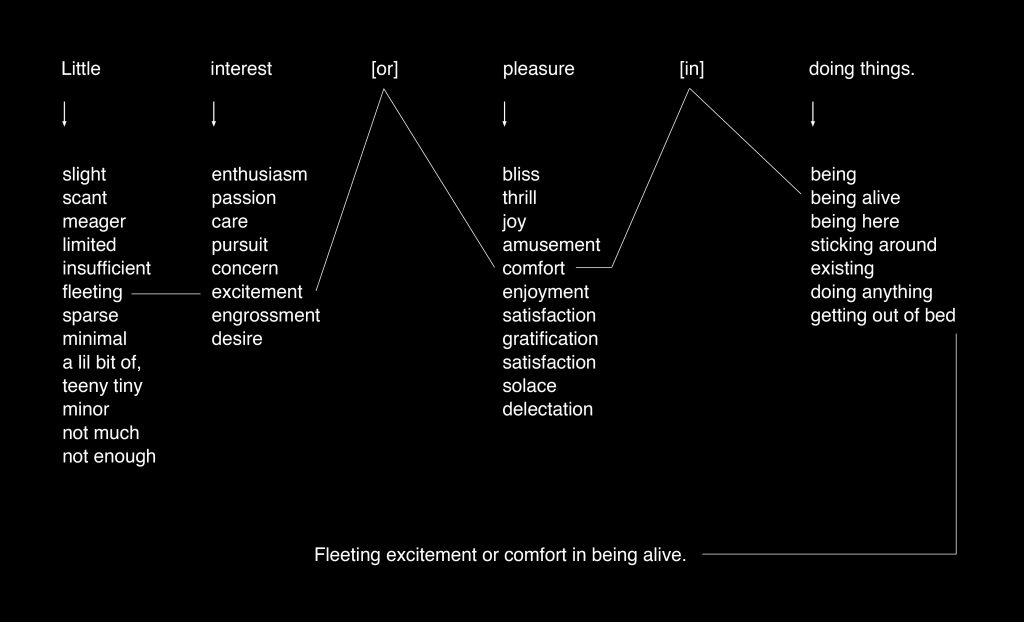
    I examined each question thoroughly and broke them down into dynamic parts. I wrote a script with new language that could be randomly generated, challenging the monotony and loss of meaning experienced by repeatedly answering the same questions. 

    I developed a tool to randomly generate new questions for both assessments, using the new vernacular that I wrote as source data.  

    In order to build this generator, I used ChatGPT to write the code that I input into p5.js. 

    Below is a list of some of the new questions that were generated using this method.

    My line of enquiry for the second method that I explored had more to do with the actual form itself.

    How can I convey the pejorative semantic shift that I have experienced by repeatedly engaging with these questions by translating the form into something that loses its meaning?

    I reproduced one hundred copies of the original form, in order to emulate the action of repeatedly completing the assessment. I wanted to utilize a bureaucratic method of reproduction which is why I chose to use a copier. . 

  • Methods of Translating: Written Task

    Susan Sontag’s writing is so decisive that it often reads like a manifesto, hence why the Conditional Design Manifesto felt like an apt method for exploration. I wanted to approach the written task for this brief from a more critical perspective, rather than a direct translation of its meaning. It was important to consider style through a contemporary lens, considering the major social, economical and technological shifts since Sontag’s essay was initially published. As a manifesto is an active document, I focused on re-contextualizing Sontag’s thesis as a critique of advertising and overconsumption. While I do understand that I am perhaps taking a more literal approach to style, I argue that the same threads are still evident. 

    REFERENCES:

    Blauvelt, A. et al. (2013) ‘Excerpt pp. ii-xiv’, in Blauvelt, A., Maurer, L., Paulus, E., Puckey, J. and Wouters, R. Conditional Design Workbook. Amsterdam: Valiz, pp. ii-xiv.

    Sontag, S. (2009) ‘On Style’, Against Interpretation and Other Essays, London: Penguin, pp. 15–36. 

  • Methods of Cataloguing: Written Task

    REFERENCES

    Crouwel, W. and Van Toorn, J. (2015) ‘The Debate’, in Poynor, R. (ed.) The Debate: The Legendary Contest of Two Giants of Graphic Design. New York: The Monacelli Press, pp. 21–38. 

  • Methods Of Investigating: Written Task

    While digesting this brief, I struggled to understand what I was looking for. I varied my search for a suitable site, ranging from Picadilly Circus to the quiet garden down the road. I couldn’t seem to define a viable method worth developing. In the first several pages of Georges Perec’s, Speicies of Spaces, I thought it felt fussy and pedantic – overly concerned with the minutia of the everyday, unnecessarily microscopic in scope. As my understanding of the work unfolded, I began to absorb the significance of his process. “Note down what you can see. Anything worthy of note going on. Do you know how to see what’s worthy of note? Is there anything that strikes you? Nothing Strikes you. You don’t know how to see.” says Perec (Perec, G.,1999, p. 50). Simultaneously inspired and insulted, I revisited my approach. Through this process of microscopic pattern recognition and by “making an effort to exhaust the subject,”  (Perec, G., 1999, p. 50) I started to see the patterns. 

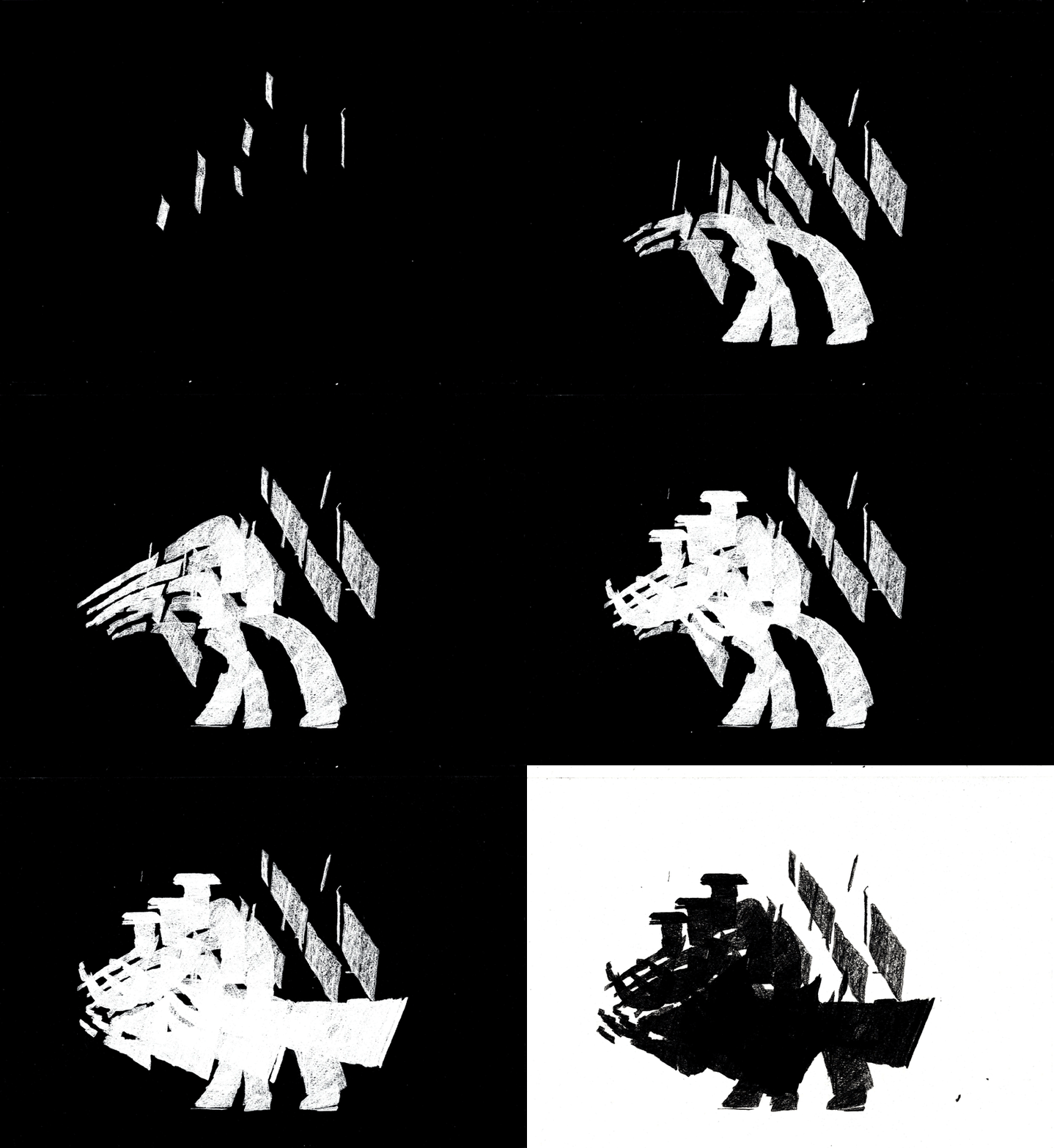
    After commiting to a site, the bus, I used this open-ended process to collect information. What struck me most intensely, was how the structure holds it’s passengers, how it moves it’s passengers and if there was a way to make the turbulence of the ride visible. By using turbulence drawing as a method, I was able to effectively collect a comprehensive dataset of bus motion, synthesize it, and develop a visual representation of how it feels to ride the bus. 

    As I reflected on this process, I found myself reconsidering how graphic design, as a practice, engages with new methods of knowledge production and further, the ways in which we sythesize and project this new knowledge. I wondered, is this data that I’ve collected a new method of knowledge production and how can it be contextualized within the field? In An Opening: Graphic Design’s Discursive Spaces, Andrew Blauvelt investigates the traditional approach to graphic design, in practice, position and outcome. While Blauvelt’s work here exists in a historical context, thematically, his concluding argument can be applied to these underlying lines of enquiry during this project, as made evident here:

    “The complex nature of the design process necessitates an understanding of it which intergrates knowledge from many different disciplines and in the process develops its own particular account. For the discursive spaces of graphic design to be opened for investigation requires that the defensive posturing and the shoring up of the walls of graphic design history be exchanged for the active examination of the “limits” of graphic design.” (Blauvelt, A., 1994, p. 216)

    I myself can attest to the capitalist induced drive to think in an outcome based, narrow and fixed mindset. It took a fair bit of deprogramming during this project to both trust and engage with an experimental practice of collecting information and an undetermined way of presenting it.

    Both of these texts had a significant impact on my work during this project. Perec’s approach informed my own, inspiring new ways of engaging with the unseen world around me. It helped define my method of investigation. Blauvelt’s criticality of traditional graphic design helped me consider the knowledge gained from the datasets that I collected and the relevance of my work within the field. 

    REFERENCES 

    Blauvelt, A. (1994) ‘An Opening: Graphic Design’s Discursive Spaces’, Visible Language, 28(3), pp. 205–217.

    Perec, G. (1999) ‘Species of Spaces and Other Pieces’. Translated by J. Sturrock. London: Penguin. In: Species of Spaces and Other Pieces, pp. 46–56.

  • Hello world!

    Welcome to myblog.arts. This is your first post. Edit or delete it, then start blogging!