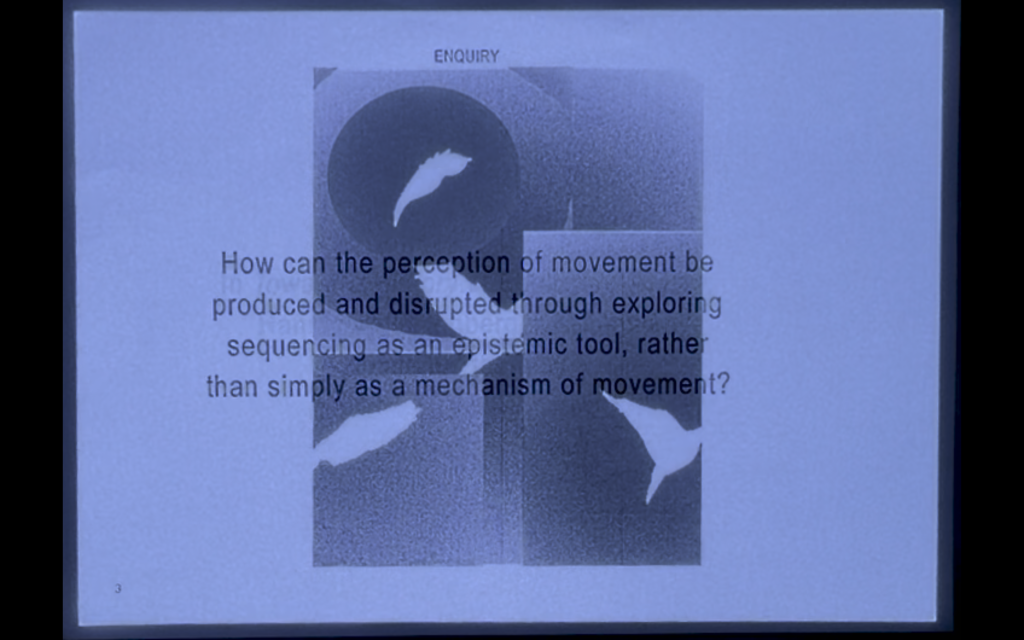
This video essay is a live, performed document of my practice over the first term of Unit 2, shot in a single continuous sequence. I used projections, a printer and cartridge paper to communicate my main enquiry, in addition to the critical findings that I’ve uncovered through my work.
Full Text
The moving image is facilitated by sequencing still frames.
How can the perception of movement be produced and disrupted through exploring sequencing as an epistemic tool, rather than simply as a mechanism of movement?
In Toward a History of Epistemic Things, Hans‑Jörg Rheinberger defines an epistemic thing as a “not-yet-fully-known” research object.
Sequencing is not simply a mechanism of movement, but rather, a knowledge producing process.
I can identify the variable constraints that produce movement:
SERIALITY
STILLNESS
TIMING
APPARATUS
RENDERING
as testable, epistemic things.
SERIALITY
There is a serial order that permits the perception of logical fluidity.
When the serial order is read collectively, movement is perceptible through adjacency, by comparing minor shifts in each frame.
There is a perceptible collapse.
Unpredictability and disorder become the subject, in lieu of a figure in motion.
STILLNESS
There is a kind of tension between stillness and movement.
When viewed simultaneously, a new perspective is formed.
Here, the field is still.
The foreground is in motion.
TIMING
When a sequence is viewed in uniform, consistent time, the perception of logical fluidity is maintained.
When the rate is absent, time reveals stillness and movement vanishes.
When the rate is slowed, time reveals seriality and movement stutters.
When the rate is accelerated, time reveals hyper-continuity and movement bleeds into itself.
When the rate is varied, time ruptures the perception of logical fluidity.
Movement becomes a container for
PRECARITY
VARIABILITY
TENSION
APPARATUS
A flip-book is an apparatus.
A GIF is an apparatus.
A phenakistiscope is an apparatus.
A zoetrope is an apparatus.
Each apparatus contextualizes movement in accordance to its own mechanics, altering the perception of still frames.
RENDERING
When I capture the figure, it illustrates movement as an object in space.
When I capture the force, it illustrates movement as a set of pressures.
The force causes the movement of the figure.
I can render flowers, shifting.
I can render a cat, running.
I can render parking signs, passing.
What happens if the figure is dissolved?
I can map the space in-between the wings of a pigeon in flight.
The force can render the figure.
In order to design movement, I render a series of still frames in order to produce a sequence by drawing or photographing.
I can print each photographic series and draw on each still frame.
I can allow the marks from the printer to leave traces of materiality.
Then I scan the still frames, rebuilding the sequence, frame by frame.
RENDER
SCAN
SEQUENCE
The imperfections produce flickers of texture.
The pressure of my hand.
The ink smudges.
The residual charcoal dust.
The slight misalignment of the frame.
These ruptures make the process visible.
When the process is made visible, there is evidence of labor.
KEY FINDINGS
Sequencing is not merely a mechanism of movement, but rather a method of producing or disrupting legibility.
By examining seriality, stillness, timing, apparatus, and rendering, I can observe how the graphical systems that I’ve developed make labor evident through ruptures.
References
Braun M., Browns Books for Students, . (2010). Eadweard Muybridge. London: Reaktion.
Hendricks G., . (2001). Eadweard Muybridge. Mineola, N.Y: Dover.
Kentridge, W. (2020) 6. PRISONER IN THE BOOK. YouTube video, 1 May. Available at: https://www.youtube.com/watch?v=xR3DCGWyFj0 (Accessed: 1 June 2026).
Pierson R., . (2020). Figure and force in animation aesthetics. New York, NY: Oxford University Press.
Rheinberger H., . (1997). Toward a history of epistemic things. Stanford, Calif: Stanford University Press.
Leave a Reply